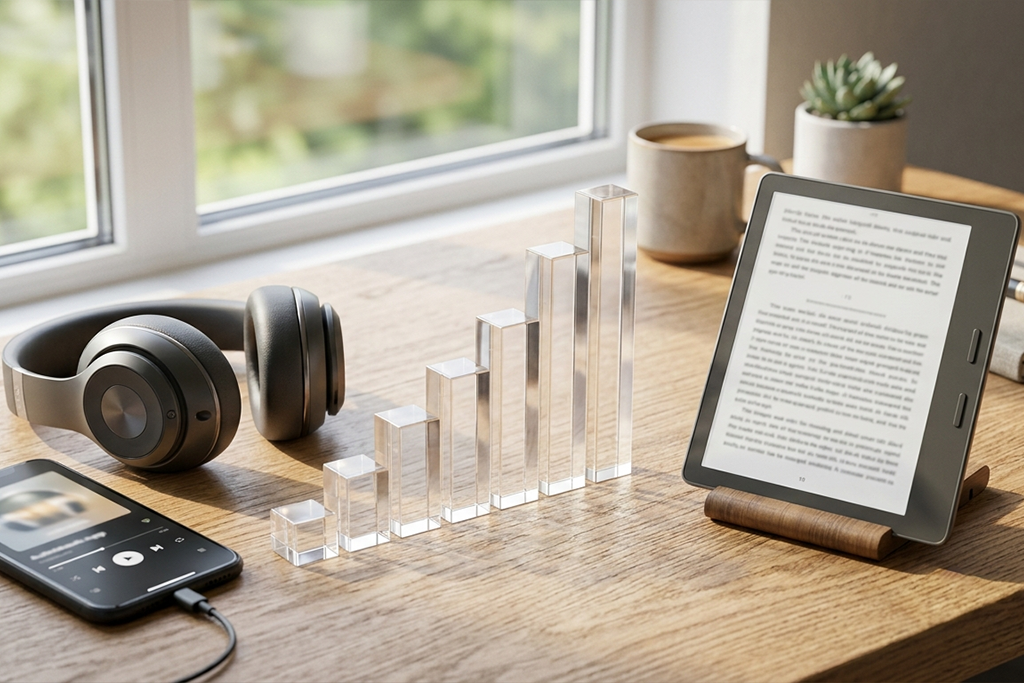
I used to think eBooks had already won the digital reading race. Then three friends, all in different age groups, listened to the same thriller on their commute last month while I sat on the train with my Kindle. That's when it hit me: this format war isn't settled. It just moved somewhere new.
If you're an author trying to decide where to put your energy first, you need real numbers, not guesses. So let's settle this properly, and let's be honest about what the data actually shows instead of repeating whatever sounds trendy this month.
Keep those four points in mind as you read on, because they explain almost everything below.
eBooks still sell more copies than audiobooks. Globally, the eBook market generated close to $14.9 billion in 2025, while the US audiobook industry brought in about $5.4 billion that same year. That's a clear gap in volume.
But copies sold isn't the whole story. Audiobooks earn more money per sale, and the format is growing faster than eBooks have in years. The global audiobook market sits around $13.8 billion in 2026, and analysts expect it to climb past $70 billion by 2033. Few segments of publishing grow at that pace.
Here's my honest take: eBooks win on volume, and audiobooks win on momentum. Anyone who insists one format has permanently beaten the other is oversimplifying a market that keeps shifting under our feet.
eBooks stay ahead in raw sales for a simple reason: they cost less to make and less to buy. Any author with a finished manuscript and a formatting tool can publish one within days. Readers grab them on impulse because a $2.99 price tag barely makes anyone pause.
Genre plays a role too. Romance and thriller fans, some of the most prolific book buyers around, still favor digital text because they read fast and read often. Write in those genres, and an eBook likely remains your bread and butter.
Audiobooks solve a problem text never could: they fit into moments when your hands and eyes stay busy. Driving, cooking, walking the dog, folding laundry. That's real time readers used to lose completely.
Nonfiction and business authors notice this shift most clearly. Listeners want to absorb ideas while multitasking, and that habit sticks. Younger readers, especially Gen Z and Millennials, reach for audio first, which tells you where reading habits head over the next decade.
Production costs also used to hold authors back from this format. That barrier keeps shrinking, and it explains why audiobook catalogs have expanded so quickly this year.

If you asked me to be blunt, here's my answer: eBooks move more units today, but audiobooks are gathering readers faster than any other format in publishing. Betting everything on one format because it "wins" right now is a decision authors regret within two years.
Publish both. Every reader consumes stories differently, and offering only one option means losing the ones who prefer the other. Authors who release an eBook and an audiobook together consistently report stronger overall sales, because each format reaches someone the other one missed.
That's exactly the problem we solve at Spark Leaf Publishing. Our team handles eBook formatting and distribution alongside full audiobook production, so your book meets readers wherever they already are, on a screen or through their earbuds.
The debate over which format sells more will keep changing every year. The authors who come out ahead won't be the ones who guessed correctly. They'll be the ones who stopped choosing sides and started publishing everywhere their readers already spend their time.
I still read on my Kindle most nights. But somewhere between the school run and the grocery run, I've become one of those people with earbuds in too. If your readers are living the same double life, your book should meet them in both places.
© 2026 Spark Leaf Publishing - All Rights Reserved